Get the complete picture of your bone health today!
Know your baseline. Track changes. Stay ahead of bone loss.
Receive Comprehensive Results Immediately
Can’t Find a Time That Works for You? Or Simply Want to Learn More?
No problem — just fill out the form below, and we’ll reach out with more information and help you find a convenient time.
Echolight REMS Bone Scan
Echolight® REMS (Radiofrequency Echographic Multi Spectrometry) is an advanced, ultrasound-based technology that allows us to assess bone health safely and comfortably — without radiation. Unlike traditional bone density scans, Echolight REMS measures both bone density and bone quality, providing a more complete and accurate picture of overall bone strength, which you can asses more frequently.
Why is it Important to Assess More Than Bone Density?

Bone quality is about more than just how dense your bones are — it’s about how strong and healthy they are overall. While bone density looks at how much mineral is in your bones, bone quality looks at how well your bones are built — including their structure, flexibility, and ability to repair themselves. Together, these factors give a more complete picture of your bone strength and risk for fracture — especially important when it comes to conditions like osteoporosis. Studies are now reporting that bone quality is a more important predictor of fracture risk.
How is Echolight REMS Different than a DEXA Scan?
Unlike DEXA, which uses X-rays and requires precise positioning to capture bone density from a single angle, Echolight REMS uses ultrasound to assess both bone density and quality. Because it collects data from multiple angles, it eliminates positioning errors, avoids interference from artifacts such as arthritis, bone spurs, or calcifications—all without any radiation exposure. The result is a clearer, more accurate picture of your true bone health.
To dive deep into this topic, check out this article on our website: https://www.missoulastrong.com/post/why-is-it-important-to-use-the-same-dxa-machine-and-technician-when-comparing-scans.
What Does Echolight REMS Measure?
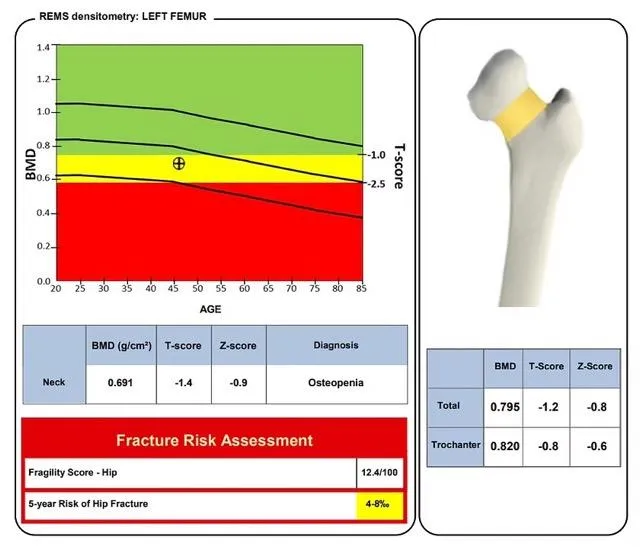
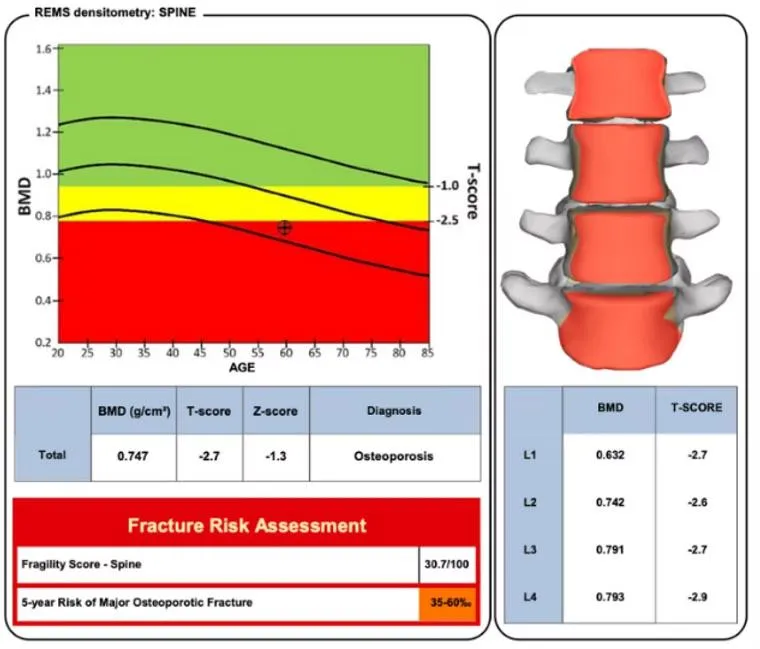
Bone mineral density (BMD): This is an actual measurement of the density of the bone (measured in gr/cm2). The BMD is used to determine the T-Score and the Z-Score. A correct osteoporosis diagnosis is entirely dependent on accurate BMD data.
T-score: This is a numeric value derived through statistical calculations that directly compares an individual’s BMD to the mean BMD value of a very large database of healthy 30 year-old. A T-score value with a standard deviation of -2.5 from the mean value establishes a diagnosis of osteoporosis.
Z-score: This is a numeric value derived in a similar manner as the T-Score, but instead, it compares your BMD to the BMD of people your own age and gender.
Fragility score: This is a numeric value calculated from scan data of microarchitecture, which is then compared to a diverse database of individuals with and without fractures. Unique to Echolight® technology, this score provides a more personalized assessment of fracture risk than DEXA scans, helping to tailor preventive measures and appropriate treatments based on individual bone characteristics providing a 5 year fracture Risk Score. This risk percentage reflects bone quality and BMD, estimating the likelihood of sustaining a fragility fracture within five years vs the traditional 10 years.
What Can I Expect During a Scan?
The scan takes about 15–30 minutes, with no wait time and appointments typically available within the same week. You’ll lie comfortably while a trained technician uses a small handheld probe over the skin to measure your lumbar spine and hip regions. It’s completely painless and doesn’t require changing clothes. You’ll receive your results immediately, and the technician will explain what the scan measured and what your results may indicate about your bone health. (Note: We are not medical providers and do not diagnose medical conditions. As with any imaging, results should be reviewed by a medical provider for formal medical interpretation.) After your appointment, you’ll also receive your results via email, along with an educational video to help you further understand and interpret them.
What Factors are Involved in Bone Quality?
Bone Microarchitecture: The structural arrangement of the bone at a microscopic level. Strong bones have a more organized, dense, and well-distributed microstructure to absorb force and can be measured with REMS.
Bone Composition: This refers to the balance of minerals (like calcium) and proteins (like collagen) in the bone. An optimal balance contributes to bone flexibility and strength.
Bone Turnover: The rate at which old bone is replaced with new bone. Healthy bone turnover helps maintain bone strength and quality, while excessive or insufficient turnover can lead to weakened bones.
Material Properties: The mechanical properties of the bone material itself, including its stiffness and elasticity, which affect how well it can resist forces and prevent fractures.
Does Insurance Cover the Cost of the Scan?
Insurance typically does not cover Echolight REMS scans, as it is a newer technology not yet widely reimbursed. However, the scan is significantly more affordable than traditional diagnostic imaging and can be scheduled directly without a referral.
Differences Between DEXA and Echolight REMS

